
DeepScan #8: Motilal Oswal Financial Services Ltd.
What's behind one of India's most diversified financial-services platforms?

Hello,
Unpopular opinion: Motilal Oswal should NOT be valued as a stockbroker.
Certainly, broking remains the entry point, but the group has evolved into one of India’s broadest capital-markets platforms, spanning financial-product distribution, lending, private wealth, asset management, alternatives, institutional equities, investment banking, housing finance and a Treasury portfolio of around ₹9,000 crore as of March 2026.
But that’s only the conclusion of a much bigger, more nuanced business. So, let’s break it down.
Note: This DeepScan is an educational analysis, not a stock recommendation. Its purpose is to help you learn how we analyse businesses. If you’re looking for actionable stock recommendations, explore Finology 30.
Capture a larger share of the clients’ financial journey.
That’s precisely what Motilal Oswal’s business model is.
A retail client may enter through a broking account and later invest in mutual funds, bonds, insurance and alternative products, borrow against securities or move into private wealth management. Wealthier clients can also invest in products manufactured within the group, including mutual funds, PMS, AIFs, private equity, real estate and private credit.
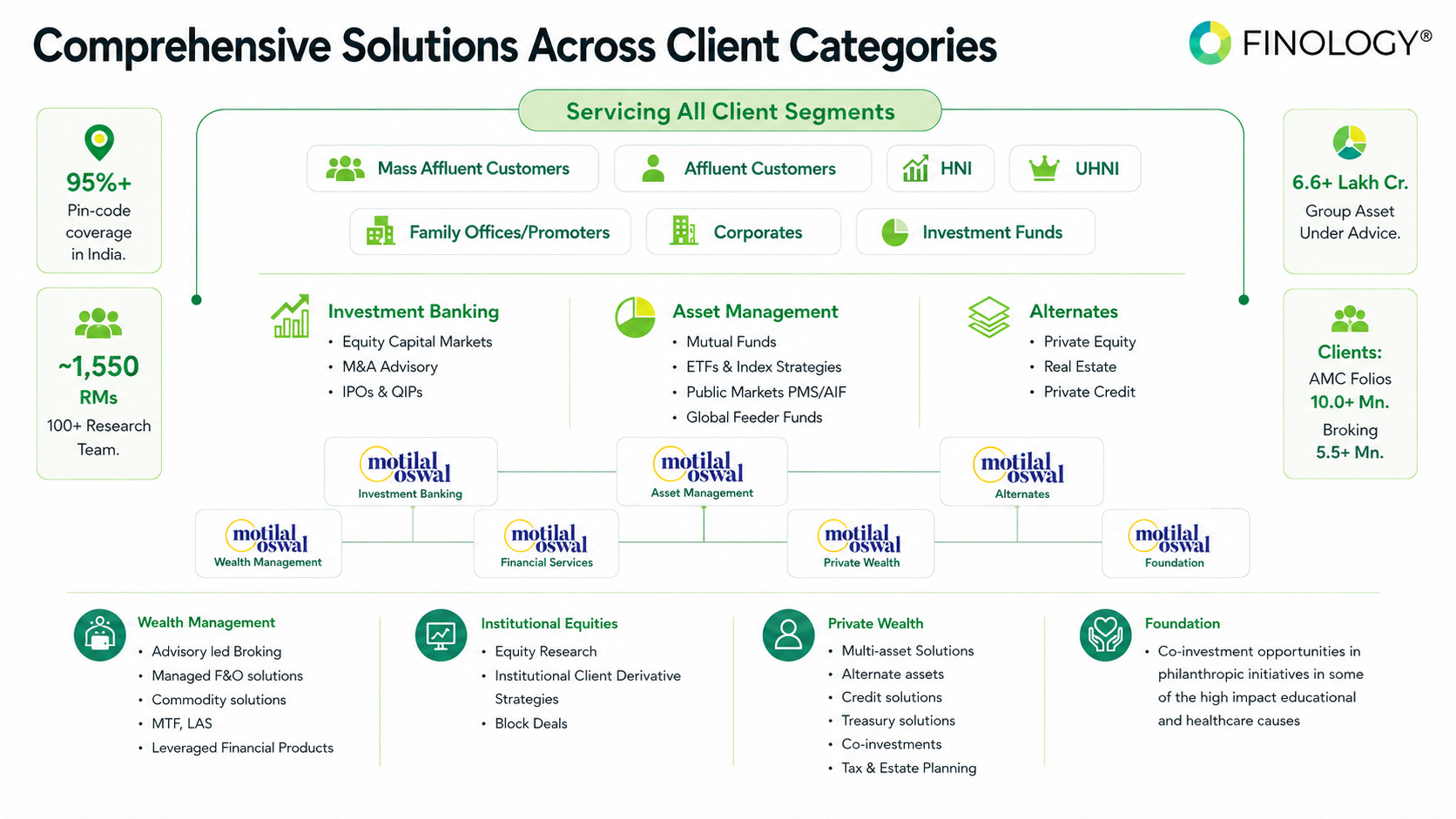
At the institutional end, Motilal Oswal:
Provides equity research, corporate access and trade execution services to both domestic and foreign institutional investors.
Helps companies raise capital through IPOs, QIPs and other investment banking transactions.
The group also operates an affordable housing-finance business with ₹5,829 crore of AUM as of March 2026.
What makes the structure distinctive is the Treasury.
Motilal Oswal reinvests part of the cash generated by its operating businesses into equities, mutual funds and alternative-investment products. This portfolio not only earns investment returns but also provides liquidity, collateral and capital to support the growth of the wider group.
Since listing in 2007, Motilal Oswal has not raised fresh equity. Its expansion has largely been funded through internally generated cash, making the Treasury both a record of past capital allocation and a source of future growth capital.
The group’s long-term track record speaks for itself. Over the decade ending FY26:
Revenue grew at a 24% CAGR over the decade ending FY26.
Operating PAT compounded at 33% CAGR over the same period.
Assets under advice increased from ₹47,074 crore to ~₹6.6 lakh crore, a 30% CAGR.
Net Worth rose from ₹1,437 crore to ₹12,888 crore, growing at a 25% CAGR.
Before we move further, an announcement: We’ve put together a detailed past performance report on the returns delivered by Finology 30 stocks over time. You can access it by opting in.
Onward and forward…
How’s Motilal Oswal structured?
1. Asset & Private Wealth Management
This segment creates investment products across mutual funds, PMS, AIFs, private equity, real estate and private credit.
Then, its Private Wealth business helps promoters, family offices and wealthy individuals invest in these products as well as third-party offerings.
Clients are broadly segmented based on financial wealth:
₹5-50 crore (Emerging HNIs)
₹50-500 crore (HNIs)
Over ₹500 crore (UHNIs)
Beyond investments, the business also offers advisory, lending, access to unlisted companies and co-investment opportunities.
This allows Motilal Oswal to earn at both ends of the value chain,
through management fees on products it manufactures, and
advisory or distribution income when those products are sold to clients.
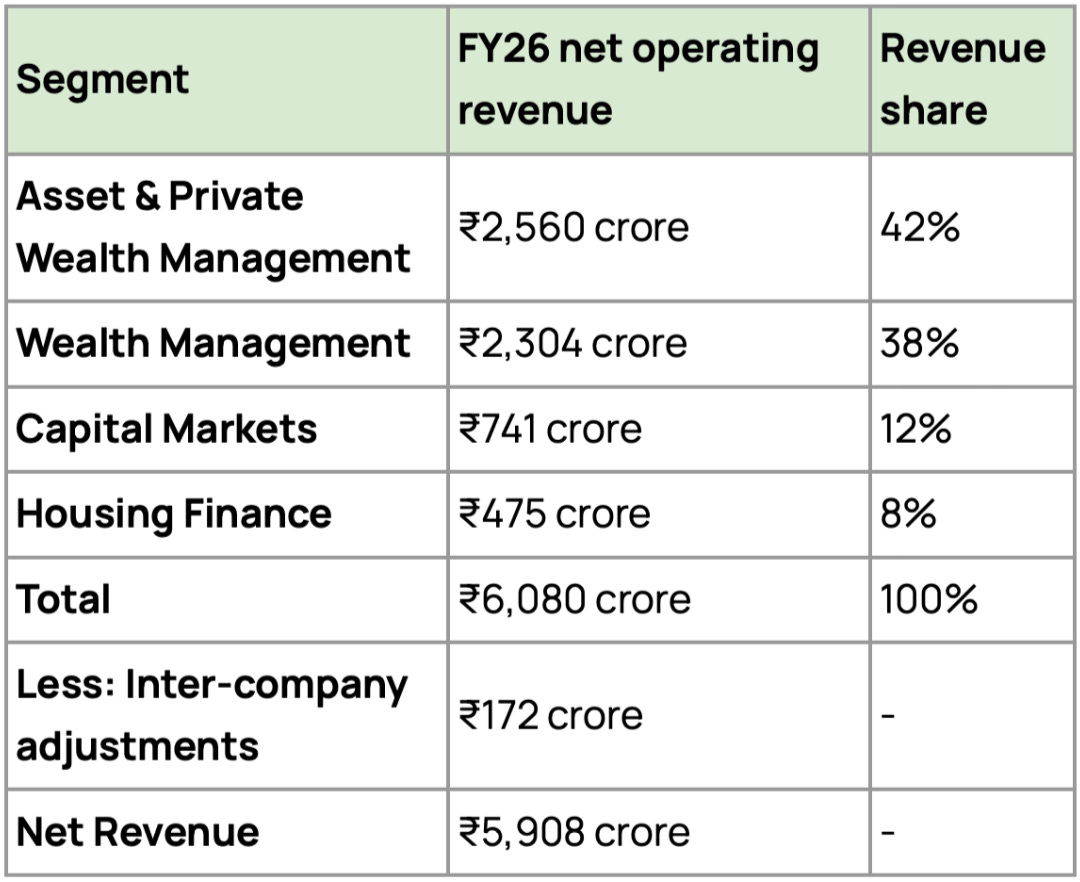
By FY26, the segment managed around ₹3.7 lakh crore of AUM, attracted nearly ~₹70,000 crore of net flows and became the group’s largest operating segment by revenue.
And what does this segment include?
Asset Management
This business has two parts: public-market investing and private-market alternatives.
I. Public-market AMC: Manages mutual funds, PMS and AIF portfolios across active and passive strategies. The business earns a small fee on the assets it manages. So, as AUM grows, whether because more money comes in or markets move higher, its revenue grows too. But most of its costs, like research, technology and compliance, don’t rise at the same pace. That’s why profits can grow faster than AUM over time.
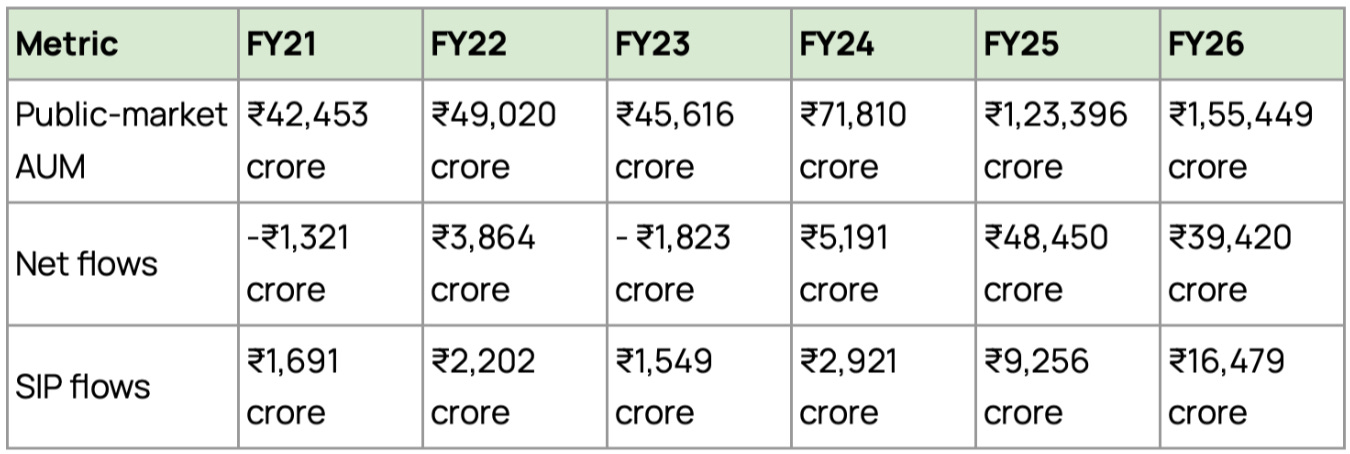
Public-market AUM increased from ₹42,453 crore in FY22 to ₹1,55,449 crore in FY26, implying a CAGR of around 30%.
Between FY21 and FY26, SIP inflows compounded at around 58% annually. In FY26 alone, SIP inflows jumped 78% YoY to ₹16,479 crore, taking Motilal Oswal’s SIP flow market share to 4.7%. As a result, its SIP AUM stood at around ₹30,000 crore by March 2026.
80% of the AUM is from Mutual funds, while 20% is from alternatives.
In FY26, the AMC captured 6.6% of industry mutual-fund net flows. It has gained market share, particularly over the last two years. Its ex-hybrid mutual-fund AUM share increased from 2.3% in FY25 to 2.7% in FY26 and 2.9% AUM market share by Q1 FY27.
By total mutual-fund average AUM, Motilal Oswal was the 17th-largest fund house in India in the Jan-Mar 2026 quarter.
Motilal Oswal is still smaller than many large AMCs, but it is attracting new investor money faster than its current size. This means its share of the mutual-fund industry is gradually increasing.
II. Private-market alternatives: The second part of the asset management business, it raises capital from wealthy investors, family offices and institutions and invests it across three private-market categories:
growth-capital private equity,
residential real estate, and
private credit.
It also plans to enter commercial real estate.
The business earns recurring management fees on the capital it manages. It can earn performance-linked income, known as carry, when fund returns exceed the agreed hurdle.
The biggest addition was IBEF V, the group’s fifth growth-capital private equity fund, which closed at ₹8,350 crore. Its first private credit fund also saw a strong response, raising ₹1,700 crore in the first close and nearly ₹2,500 crore by Q1 FY27, against a ₹3,000 crore target.
Next in line are the group’s first commercial real estate fund and Series VII of its residential real estate fund. The commercial real estate fund had received regulatory approval by Q1 FY27 and was planned for launch in the second half of FY27.
The platform’s track record has helped it raise progressively larger funds. Across IBEF I-IV, Motilal Oswal reported gross IRRs ranging from 17.2% to 26.0%, while IREF II-VI reported 17.3% to 21.0%. These include both realised exit IRRs and unrealised value IRRs.
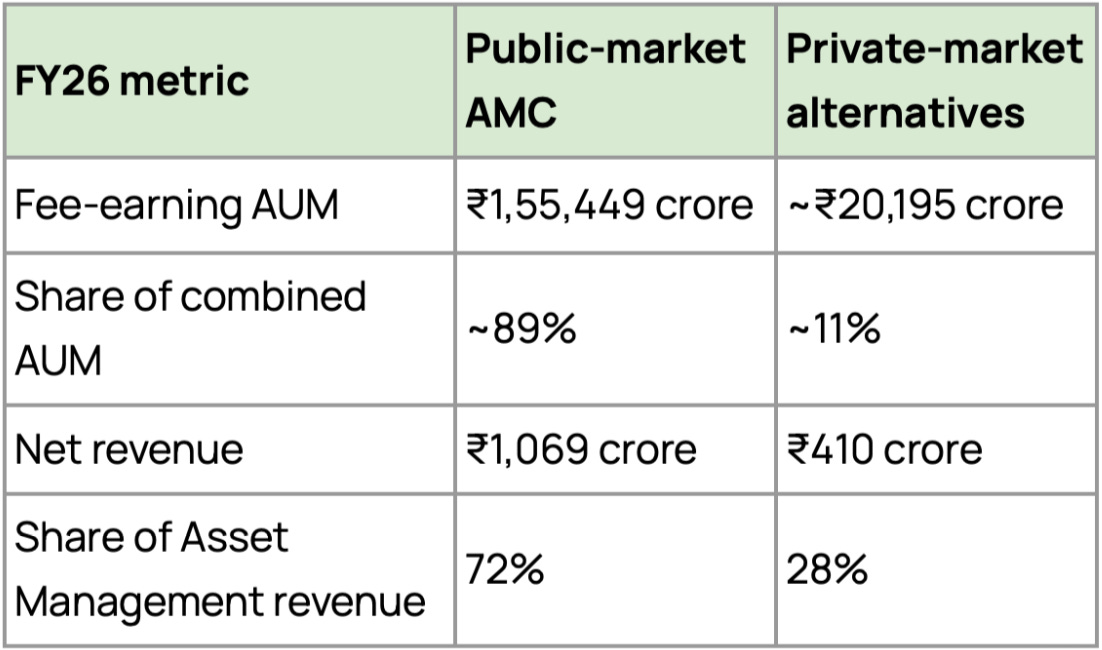
On a simple net-revenue-to-average-AUM basis, the private-market business generated roughly four times as much revenue per rupee of AUM as the public-market AMC in FY26.
The reason is that public-market yield largely reflects management fees, while private markets also earn performance-linked carry, along with interest and other income from real estate and private credit.
For instance, the alternatives business recognised around ₹58 crore of carry accrual in Q3 FY26 alone.
Asset Management contributed 33% of operating PAT in FY26, up from 26% in FY25, making it one of the group’s most important profit engines.
Momentum continued in Q1 FY27. Total Asset Management AUM, including MO Alternates, crossed ₹2 lakh crore. Public-market average AUM rose to ₹1.81 lakh crore, mutual fund AUM market share reached 2.9%, SIP AUM touched ₹38,643 crore, and Asset Management’s share of group operating PAT increased to 40%, from 26% a year earlier.
Now, coming to the latter half of MO’s Asset & Private Wealth Management segment…
Private Wealth Management
This business primarily serves families with more than ₹5 crore of financial wealth. Through dedicated relationship managers, it caters to emerging HNIs, HNIs, UHNIs, promoters and family offices.
Over FY22-FY26, Private Wealth AUM grew from ₹55,367 crore to ₹1,96,716 crore, compounding at around 37% annually.
The platform offers:
Portfolio advisory and asset allocation
Mutual funds, PMS and AIFs
Bonds and structured products
Private-equity and real-estate funds
Unlisted and co-investment opportunities
Loans against securities and investment assets
Access to the group’s institutional-equities and investment-banking capabilities
Revenue comes from a mix of recurring and transaction-based income.
Recurring revenue includes trail income, advisory fees and interest income.
Transaction-based revenue comes from broking, unlisted transactions, product placements and other one-time opportunities.
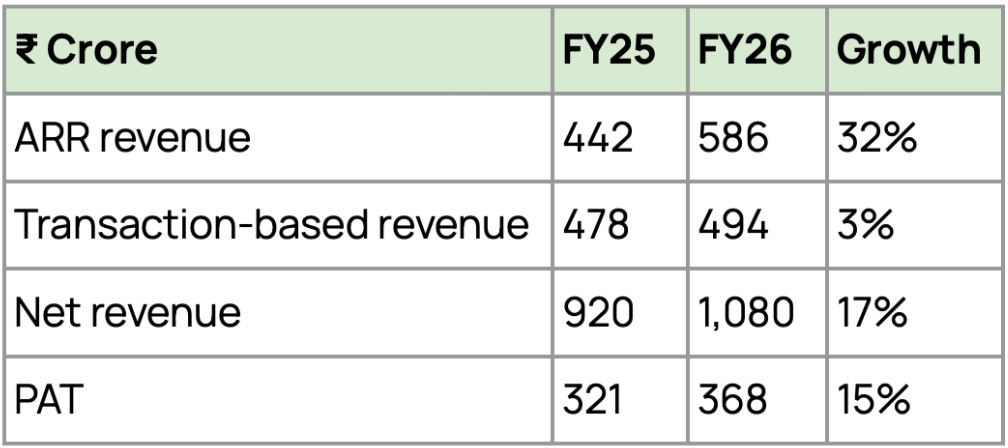
ARR contributed around 54% of FY26 revenue, up from 48% in FY25. This improves earnings visibility. Even so, transaction-linked income still contributed 46%, leaving revenue sensitive to market conditions and deal activity.
The larger opportunity is increasing recurring monetisation of the existing asset base. ARR AUM was around ₹46,000 crore in FY26, equivalent to only about 23% of total Private Wealth AUM. The remaining assets may still generate transactional income, custody or relationship value, but do not provide the same predictable revenue stream.
The relationship-manager base increased from 199 in FY23 to 440 in FY26. However, only 32% of RMs had completed more than three years with the company by March 2026.
Private-wealth RMs usually take several years to establish trust, transfer client assets and reach mature revenue productivity. Motilal Oswal is therefore carrying the cost of a relatively young RM team before receiving its full revenue benefit.
That operating leverage wasn’t visible in FY26. Revenue grew 17%, while PAT grew slightly slower at 15%, with the implied PAT margin moderating from 34.9% to 34.1%. The payoff is likely to come only if the company retains these RMs and they continue growing their AUM and revenue per relationship.
The business, therefore, isn’t as mature as its AUM might suggest. Only around 23% of AUM generated recurring revenue in FY26, while nearly half of revenue remained transaction-linked.
In our view, the real value creation depends on converting more client assets into ARR AUM and improving productivity from the young RM base. Total AUM growth is encouraging, but recurring revenue growth and RM productivity are the more important measures of business quality.
2. Wealth Management
This is Motilal Oswal’s retail and mass-affluent financial-services platform with three revenue engines:
Broking: Clients trade equities, derivatives and commodities, generating brokerage and transaction income.
Distribution: The company distributes mutual funds, PMS, AIFs, bonds, insurance and other financial products, earning recurring trail fees as well as transaction-based income.
Lending: Mainly Margin Trading Facility and other loans against financial assets, generating net interest income.
Its overall retail broking market share stood at 7.6% in Q1 FY27, with F&O premium share also at 7.6% and MTF share at around 6.5%. Cash-volume market share remained broadly stable at around 7%, but Motilal Oswal was the largest non-bank broker by cash brokerage revenue market share, partly because its full-service model earns higher brokerage per unit of turnover while discount brokers typically charge nil or very low brokerage on cash trades.
For perspective, on a ₹1 lakh delivery purchase, Motilal Oswal’s standard brokerage is around ₹200, compared with ₹0 at Zerodha and ₹20 at Groww.
This combination has gradually changed the segment from a largely transaction-driven broker into a broader wealth platform.
The revenue mix has evolved beyond broking.
In FY21, broking contributed around 60% of Wealth Management revenue, but in FY26, as distribution and lending grew faster, its share declined to about 35%.
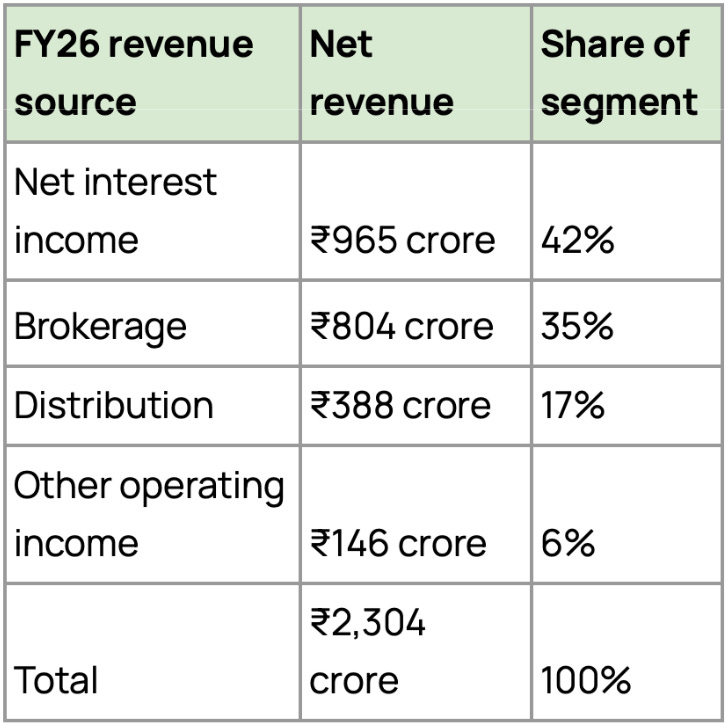
Distribution and net interest income together contributed around 59% of FY26 segment revenue, up from about one-third in FY21.
Unlike broking, which depends on market activity and trading volumes, distribution trails and lending income are generally more recurring. As a result, the business now enjoys better revenue visibility than it did a few years ago.
Yet, broking remains the customer-acquisition engine.
Motilal Oswal continues to be one of India’s leading full-service brokers. Its combined market share across cash equities, F&O and commodities increased from 8.2% in FY25 to 8.6% in FY26. It is particularly strong in cash equities, where its market share stood around 7%.
Unlike discount brokers, Motilal Oswal doesn’t compete on low brokerage alone. Instead, it offers research, investment advice, relationship managers, branch access, and products such as mutual funds and lending.
Its phygital model combines the RiiSE app with a large physical distribution network. At FY26-end, the platform had around 1,100 internal relationship managers, 7,610+ external wealth managers and 76 branches, with the broader network covering more than 95% of Indian PIN codes.
The franchise-led network helps keep upfront customer-acquisition costs low, but the distribution is not free. MOFSL paid ₹1,053 crore of brokerage-sharing commissions to intermediaries in FY26.
The flip side is that much of this cost is variable. Around 67% of the Wealth Management cost base varies with business activity. So, when trading volumes slow, brokerage-sharing payouts also decline, cushioning the business during weaker market conditions.
Lending has become the largest revenue source.
The Wealth Management loan book increased 32% to ₹6,094 crore in FY26. Net interest income rose from ₹834 crore to ₹965 crore and became the segment’s largest revenue source.
A major part of the loan book consists of MTF, where Motilal Oswal funds part of a client’s share purchase and earns interest until the amount is repaid.
The company’s MTF market share was close to 7% in FY26, broadly in line with its cash-broking market share. Management believes there is room for further growth, as only around 15% of existing cash customers used MTF, and said there was significant scope to penetrate the existing client base further.
Lending improves revenue visibility because interest continues to accrue while the loan remains outstanding. However, it also makes the segment more capital-intensive than a pure broking or distribution business. Growth therefore depends on access to competitive funding, prudent leverage and disciplined collateral management.
The main risk in MTF is a sharp market correction. Since the loans are backed by shares, falling stock prices can reduce the value of the collateral and trigger margin calls. If clients fail to provide additional funds and the shares cannot be sold quickly enough, Motilal Oswal may face credit losses.
Broking is no longer the primary earnings driver here. The client and distribution network created through broking is increasingly being monetised through investment products and lending, with distribution and net interest income now contributing the majority of segment revenue.
The direction is positive, but the quality of the three revenue streams remains different. Broking is cyclical, distribution includes both recurring and lumpy income, while lending is more predictable but consumes capital and adds balance-sheet risk.
3. Capital Markets
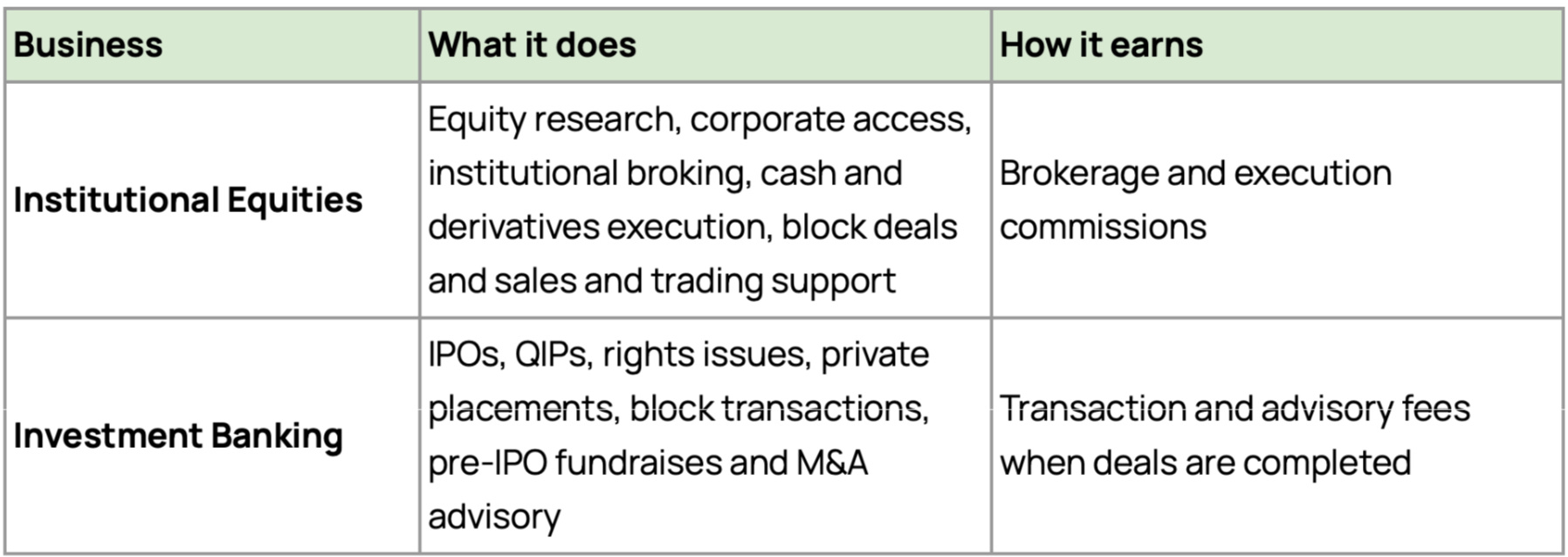
This segment serves institutional investors, listed and unlisted companies, promoters and private-equity investors through two businesses:
Capital Markets revenue increased from ₹197 crore in FY21 to ₹741 crore in FY26, implying a CAGR of around 30%.
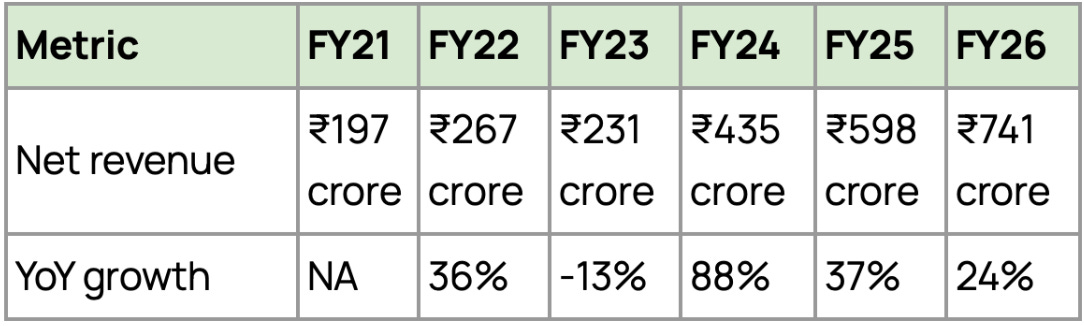
Sure, the headline CAGR looks strong, but the yearly trend shows the true nature of the business. Revenue declined in FY23, nearly doubled in FY24 and continued growing strongly in FY25 and FY26.
Don’t think of it as an annuity business like asset management. Institutional brokerage depends on trading activity, while investment-banking fees depend on transactions actually closing. One or two large block deals, IPOs or QIPs can materially change quarterly revenue.
The Institutional Equities business serves domestic and foreign institutional investors through research, corporate access and trade execution. Fund managers handling large pools of capital require detailed macroeconomic and company research, access to management teams and reliable execution across cash equities and derivatives. Motilal Oswal earns brokerage commissions when these trades are executed through its institutional dealing platform.
The strength of the franchise lies in its research depth and corporate access.
Research: By the end of FY26, Motilal Oswal covered 366 listed companies across 27 sectors, representing approximately 76% of India’s total market capitalisation. The platform was supported by more than 150+ employees serving over 900 institutional clients.
Corporate access: The company connects institutional investors with company management teams through conferences, meetings, and sector events. Its flagship Annual Global Investor Conference attracted more than 200 corporates and 1,200 investors in FY26, covering companies that represented roughly 45% of India’s public-equity market capitalisation.
Investment Banking operates on the other side of the capital market. It advises companies on IPOs, Qualified Institutional Placements, private placements, mergers and acquisitions, restructuring and other capital-raising transactions. Revenue is largely milestone-driven and is earned as a fee linked to the size and successful completion of a transaction.
Historically, Investment Banking was a relatively small contributor. The business was restructured in FY23 under a new leadership team, with greater focus on larger transactions, stronger deal origination and deeper use of the group’s institutional relationships. The turnaround gained momentum over the following years, with Investment Banking revenue growing 50% in FY26.
Segment net revenue increased from ₹197 crore in FY21 to ₹741 crore in FY26, implying a CAGR of 30.33%. Research coverage also expanded from 204 companies to 366 over the same period, reflecting the scale-up of the institutional platform.
The segment is also relatively capital-light, although institutional broking requires cash deposits and high-grade collateral with exchanges and clearing corporations. These margins are necessary to support large institutional trades.
Now, Motilal Oswal partly meets this requirement through its crore proprietary Treasury portfolio. Liquid investments can be pledged to raise collateral-backed funding lines and bank guarantees, allowing the broking platform to support higher trading volumes without requiring fresh equity dilution.
This creates a useful connection between the group’s treasury and its capital-markets franchise. But it also means that part of the balance sheet remains indirectly exposed to market conditions and collateral requirements.
The largest weakness of Investment Banking is the lumpiness of revenue.
IPOs, QIPs and block deals can be completed only when the market window is supportive. When geopolitical shocks, weak equity markets or valuation concerns delay transactions, fee income can fall sharply even when the underlying mandate pipeline remains healthy.
Motilal Oswal is also expanding beyond traditional investment banking. It is building capabilities in private equity advisory, mergers and acquisitions, restructuring, unlisted transactions and private debt placements. These businesses aren’t completely immune to market cycles, but they do provide a broader pool of fee income when public equity issuance slows.
4. Housing Finance
The group operates its affordable housing-finance business through Motilal Oswal Home Finance Limited, or MOHFL. Unlike its largely fee-based capital-market businesses, housing finance is a balance-sheet-led business that earns the difference between the interest charged to borrowers and its own funding cost.
In FY26, portfolio yield was 13.7%, cost of borrowing 7.9% and NIM 7.0%.
MOHFL focuses on low- and middle-income households in Tier-2 and Tier-3 markets, particularly self-employed and cash-salaried borrowers who may not have complete formal income documents. Loans are assessed through cash-flow checks, proprietary credit models and field-level verification. The network covered 126 branches across 12 states in FY26, with Maharashtra remaining the largest market.
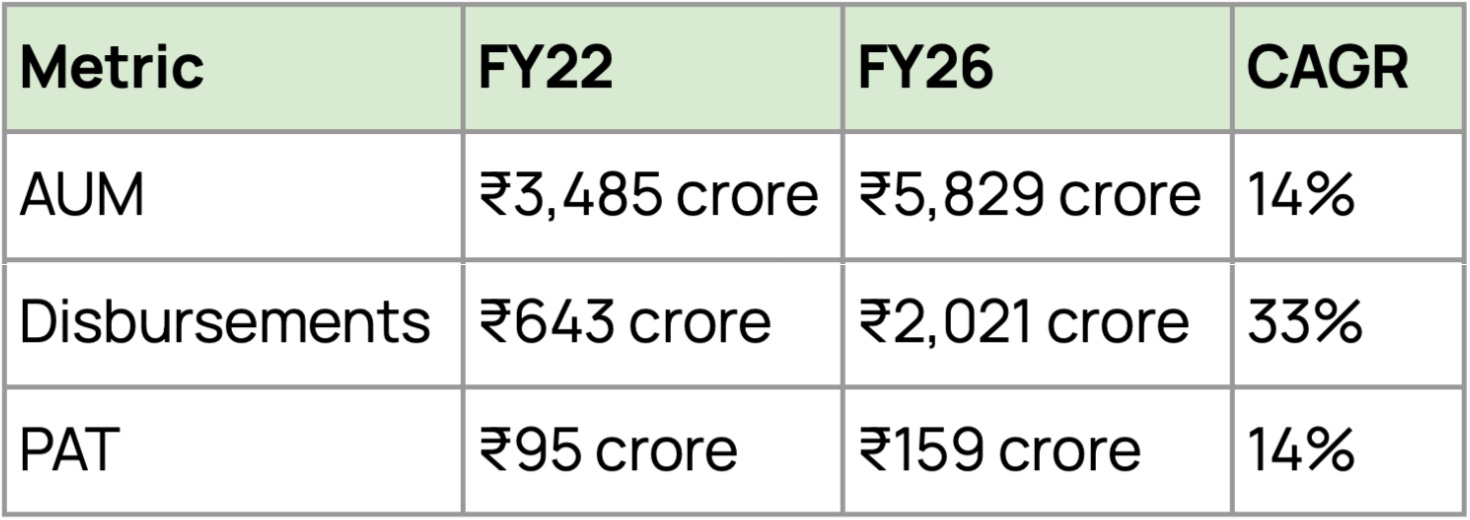
Disbursements have grown much faster than AUM, especially over the last two years, as branch productivity improved and the sales network expanded. Asset quality remained healthy, with GNPA of 0.9% and NNPA of 0.5% in FY26.
MOHFL follows a cautious lending approach.
On average, it lends only ₹58 for every ₹100 of property value, leaving a 42% safety cushion if property prices fall. Borrowers’ total monthly loan repayments are limited to around 44% of their income, reducing the risk of over-borrowing. The company operates through 126 branches across 12 states, with Maharashtra as its largest market.
5. Treasuries
This is the group’s own investment portfolio, built by reinvesting surplus profits after dividends and buybacks.
In wealth and asset management, nothing builds client trust faster than a manager who invests alongside them.
MOFSL is the largest single investor in almost every fund it offers. By the end of FY26, the group’s total skin in the game stood at over ₹9,600 crores, consisting of ₹6,600+ crores in sponsor commitments from the corporate treasury and ₹2,900+ crores in personal investments from the founders and promoters.
Standalone treasury investments have grown at a 40% CAGR since their inception in FY14. This rapid expansion has been driven by a dual engine: the organic performance of their investments (averaging a blended long-term internal rate of return of 15.5% since inception) combined with the systematic reinvestment of residual operating profits.
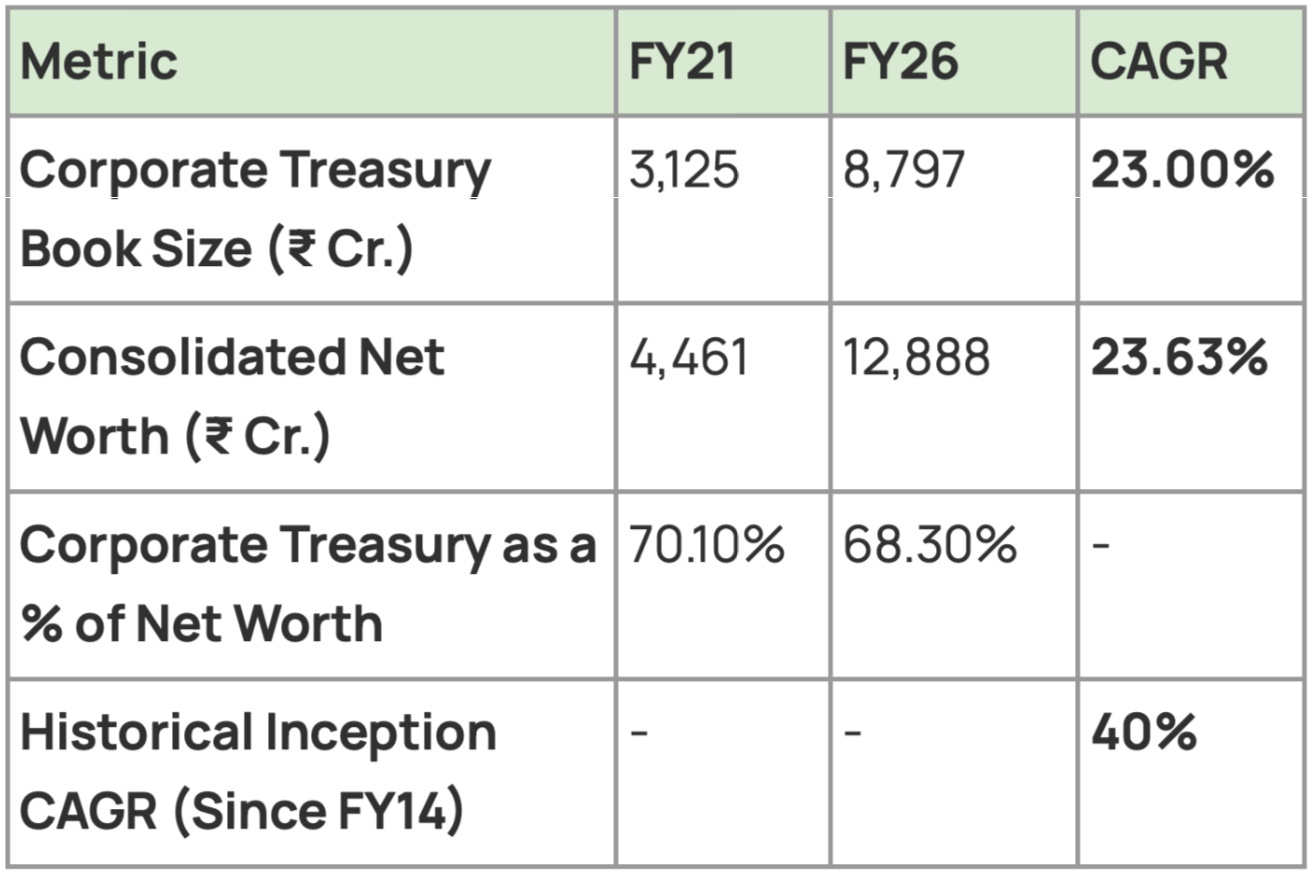
The treasury creates substantial earnings volatility because mutual funds and several financial investments are marked to market every reporting period. Therefore, reported PAT can move sharply even when brokerage, asset management, wealth and lending operations remain healthy.
Q4 FY26 is the clearest example. Core operating PAT grew 25% YoY to a record ₹661 crore, but a ₹1,054 crore treasury MTM loss pulled total PAT to a loss of ₹393 crore. Most of the decline was subsequently recovered during April as markets rebounded.
It is a compounding machine that has grown 55x in just over a decade without any equity dilution, acts as low-cost collateral to support the expansion of retail lending, and provides substantial “skin in the game,” helping the company build trust among HNI and family-office clients.
Now, we move to…
What comes next for Motilal Oswal?
A few long-term trends could play an important role here.
1. Financialisation of household savings
It’s the largest long-term opportunity. As incomes rise, a greater share of savings is gradually moving from physical assets such as gold and real estate into equities, mutual funds and other financial products.
Management expects India’s GDP to increase from around ₹370 lakh crore to ₹1,615 lakh crore over the next 17 years. Over the same period, cumulative gross domestic savings could rise from around ₹1,283 lakh crore to ₹4,465 lakh crore.
Yet capital-market penetration remains low. Indian households hold only around 5% of their wealth in equities, compared with 40% in the US, while mutual-fund AUM is only 20% of GDP versus 120% in the US.
Also, the investor base is already widening. Demat accounts increased from 4.1 crore in FY20 to 22.5 crore in FY26. As an integrated capital-markets group, Motilal Oswal can capture this shift across broking, distribution, lending, asset management, private wealth and investment banking.
2. Wider distribution as funds complete three years
A specific growth trigger for the AMC is the ageing of its mutual-fund portfolio. Banks, national distributors, wealth managers and digital platforms generally prefer active funds with at least a three-year performance history before recommending them to clients.
Only six active schemes currently have a track record of more than three years. These operate in categories representing 44% of the mutual-fund industry’s active AUM. Two more funds, including the Small Cap and Large Cap schemes, are expected to complete three years by March 2027.
By March 2028, 16 active funds are expected to have a three-year track record, expanding Motilal Oswal’s addressable product coverage to categories representing 75% of industry AUM.
If these funds continue to perform well, they could see wider third-party distribution and attract meaningful inflows without a proportionate increase in costs. That would support AUM growth, fee income and operating leverage, while reducing the AMC’s reliance on a relatively small set of strategies.
3. Cross-selling to 55 lakh retail clients
Motilal Oswal has more than 55 lakh registered retail clients, supported by a network of over 7,610+ franchisee partners. Most of these customers were originally acquired for stockbroking, creating a large base that can be cross-sold mutual funds, insurance, bonds and other financial products.
The current third-party product cross-sell ratio is only 18%. This means more than 80% of retail clients have not yet purchased a distributed financial product through Motilal Oswal.
To improve this, Motilal Oswal has appointed a separate head for third-party products, supported by a 600- 700-member specialist team that works alongside broking RMs. The relaunched RIISE app adds a digital layer by bringing together internal and external portfolios, AI-led research, market insights and investment/trading tools. MO Research Assistant handles AI-based stock and sector analysis, while MO Genie is mainly an AI-powered service and information chatbot.
If this strategy works, more clients could gradually move from transaction-based broking to trail-paying products. Annual recurring revenue already contributes 60% of group net operating revenue, and deeper penetration within the existing client base could increase this share without a similar increase in customer acquisition costs.
4. Using the balance sheet to expand lending
Since listing in 2007, the company has not raised fresh equity and has instead compounded retained earnings through its ₹8,797 crore Treasury portfolio.
In FY26, ICRA upgraded the company’s credit rating to AA+ (Stable). According to management, Motilal Oswal became the first non-bank domestic capital markets player in India to receive this rating.
The upgrade improved access to funding and helped reduce the MOHFL’s cost of borrowing to 7.9% in FY26. Management expects a further reduction of 0.15%-0.20% over the next 12-18 months, which could support lending margins.
The balance sheet also retains significant growth capacity. The home-finance subsidiary had a Capital Adequacy Ratio of 37.5%, while consolidated gearing remains conservative. This gives the group room to expand its lending businesses substantially over the next three years without depending on fresh equity capital.
Speaking of long-term opportunities, this month’s Finology 30 features stocks widely owned by Indian mutual funds, with both DIIs and FIIs invested alongside.
Institutional ownership isn’t our investment thesis, but it often reflects businesses that have earned the confidence of long-term capital.
What about the management’s ability to execute?
Take a look at the comparison of management’s FY26 guidance versus the actual FY26 performance:
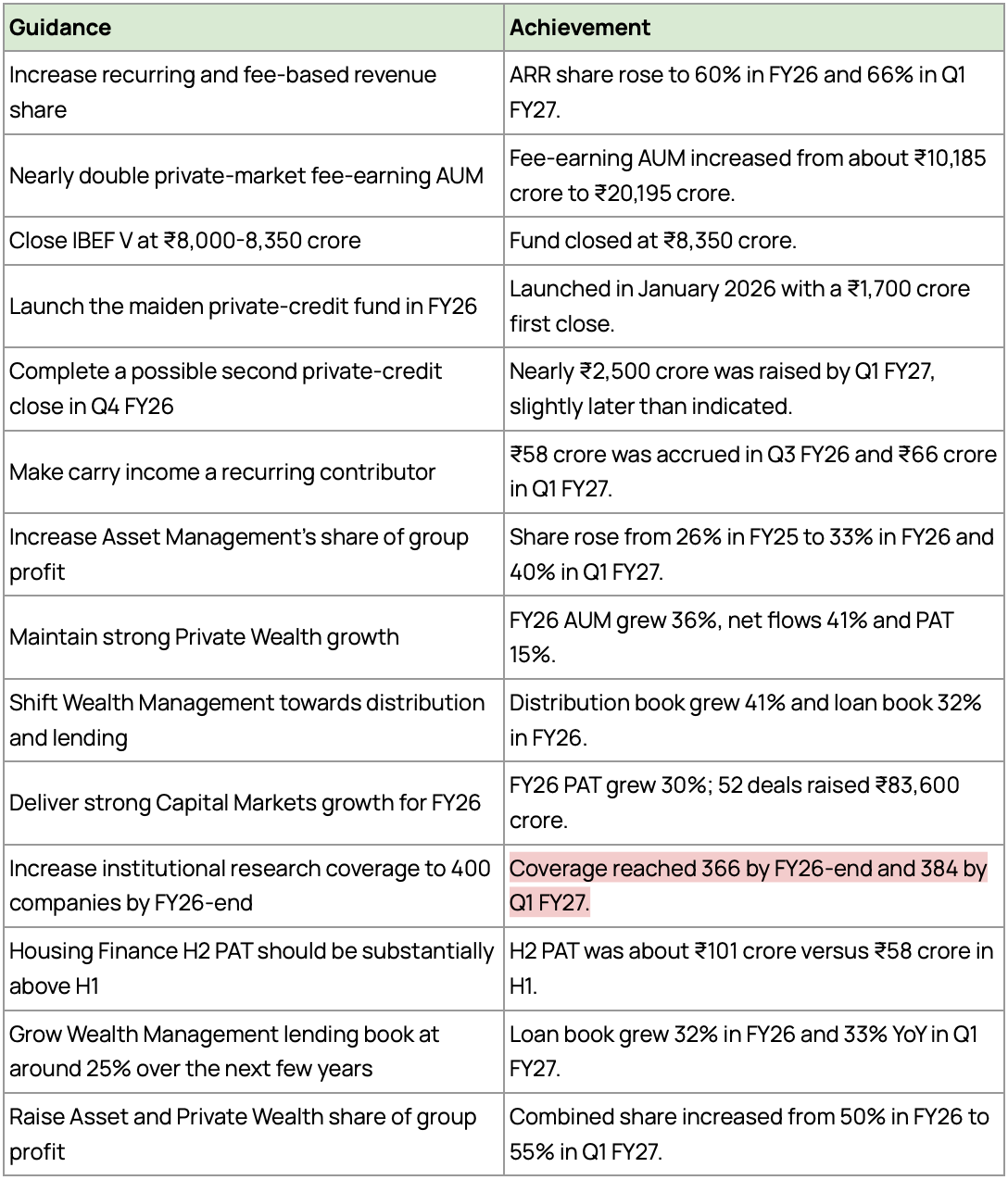
Management’s execution was strong on the major strategic commitments. It delivered the IBEF V fundraise, launched private credit, doubled private-market fee-earning AUM, expanded recurring revenue and increased Asset Management’s share of profit.
What could go wrong?
1. Capital-market and treasury volatility
Motilal Oswal’s twin-engine model also comes with a trade-off. While it strengthens the balance sheet, it makes reported earnings more sensitive to equity markets.
In FY26, operating PAT reached ₹2,360 crore. However, MTM losses on the treasury portfolio brought total PAT, including OCI, down to ₹2,043 crore.
The impact was even more visible in Q4 FY26, when a ₹1,054 crore notional treasury loss pushed reported PAT to a loss of ₹393 crore, despite healthy operating profits. According to the company, a 10% decline in equity and mutual fund values could reduce consolidated PBT by around ₹1,024 crore.
The same volatility can weigh on reported ROE as well. In FY26, standalone ROE declined from 19.47% to 14.90%.
2. Regulatory and fee pressure
The business remains exposed to changes in trading rules, market volumes and fee structures. Brokerage generated ₹1,395 crore net operating revenue, and remains linked to F&O and cash-market activity.
As per the management, the proposed regulatory changes could reduce group operating PAT by 1-2%, while the direct revenue impact on the capital markets segment could be around 5-6%. Continued regulatory tightening could therefore affect volumes, brokerage yields and margins.
3. Lending, leverage and credit quality
Motilal Oswal is borrowing more to grow businesses like MTF, loans against securities and housing finance. In FY26, gross borrowings rose 44% to ₹21,255 crore. After adjusting for cash, net debt stood at ₹16,094 crore. That means the company now has ₹1.24 of net debt for every ₹1 of equity, up from ₹0.73 a year ago.
There’s nothing inherently wrong with that. More leverage can improve ROE as long as lending spreads remain healthy. But it also leaves the business more exposed if borrowing costs rise or loan growth slows.
Credit-quality data needs a balanced reading. Stage 2 loans, where borrower risk has increased but the account is not yet in default, rose from ₹56 crore to ₹172 crore. Their share of the gross loan book increased from roughly 0.5% to 1.2%, making this the main area to monitor.
Stage 3 loans, which are already credit-impaired, also increased from ₹23 crore to ₹30 crore. But because the overall loan book grew much faster, their share stayed broadly unchanged at around 0.2%.
Coming to valuations…
Motilal Oswal trades at around 26x earnings, nearly 37% above its historical median P/E of 19x. The current valuation reflects expectations that Asset Management, Private Wealth, distribution and lending will continue increasing their share of group profits.
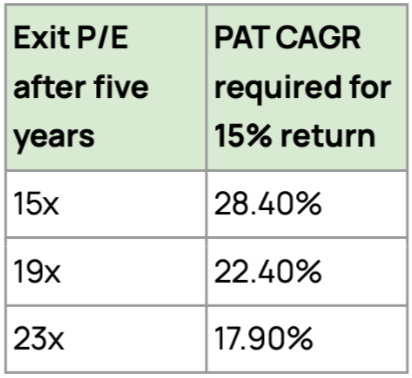
If the valuation returns to 19x after five years, PAT must compound at around 22.4% annually to deliver a 15% return, excluding dividends. At the same exit multiple, 18% PAT growth would generate an annual return of around 10.8%, while 20% growth would deliver roughly 12.7%.
Motilal Oswal has delivered strong long-term profit growth, although FY26 operating PAT increased by a relatively moderate 16%. Faster growth in Asset Management and Private Wealth, supported by rising AUM and operating leverage, will therefore be important.
We believe improving earnings mix justifies some premium to history. But, at 26x, investors are already paying for PAT growth of more than 20% over several years.
In our view…
Motilal Oswal today looks more like an asset and wealth manager than a broker.
In FY26, Asset Management and Private Wealth contributed around 50% of operating PAT, 42% of net operating revenue, and managed ₹3.7 lakh crore of assets. Five years ago, they accounted for just 35% of revenue, while broking made up 60% of Wealth Management revenue, compared with 35% in FY26.
The earnings mix is clearly becoming more recurring, although broking activity and treasury-related market volatility remain key risks.
Lastly, remember, DeepScans are an extension of the research process we follow at Finology 30. While not every company we analyse becomes an investment candidate, every DeepScan is an opportunity to understand how a business works.
Finology’s Exclusive Updates
From Ticker: Organised Eyewear & Prescription Retail
Rising screen time and eyewear becoming a fashion purchase are driving consumers toward organised optical chains, creating opportunities for category leaders.
Don’t buy generic retail stocks; use Ticker to isolate the true category leaders:
High Gross Margins: Check the Profit & Loss tab. Prescription lenses and private-label frames carry massive markups and high Operating Profit Margins (OPM).
SSSG & Store Expansion: Check Documents for strong Same-Store Sales Growth (SSSG), proving revenue is driven by real footfalls.
Inventory Turnover: Look at the Ratios tab for dropping inventory days - fast turns mean frames move without heavy discounts.
Use Ticker to find organised eyewear chains gaining market share as the category expands.
That’s a Wrap for Today!
We’re always looking for interesting businesses and industries to explore.
If you enjoyed this DeepScan, we’d love to hear from you. And if there’s a company, industry, or business model you’d like us to break down next, simply reply to this email or drop a comment.
See you in the next edition!
Pranjal Kamra
Research: Jayesh Mohta
Editorial: Mehvish Qureshi
Disclaimer
Investment in securities market are subject to market risks. Read all the related documents carefully before investing. The information and analysis provided herein are for educational and informational purposes only and do not constitute investment advice, a research recommendation, or an offer, solicitation, or recommendation to buy, sell, or hold any security. Investors should exercise their own judgment, conduct independent due diligence, and consult professional advisers before making investment decisions. Finology Ventures Private Limited, its affiliates, directors, employees, and research analysts shall not be liable for any loss or damage arising from the use of or reliance on this information.
SEBI Registered Research Analyst Details:
Registered Name : Finology Ventures Private Limited (RA Division)
Registration No : INH000024277
BSE Enlistment No. : 6877
Validity : Dec 16, 2025 - Dec 15, 2030
The shift towards wealth management is REAL
Why Sir you only do deep scan on AMC companies