
Why Most Investors Overpay And How GARP Fixes That
Here's why Paying the Right Price for Growth Stocks Is the Key to Long-Term Wealth

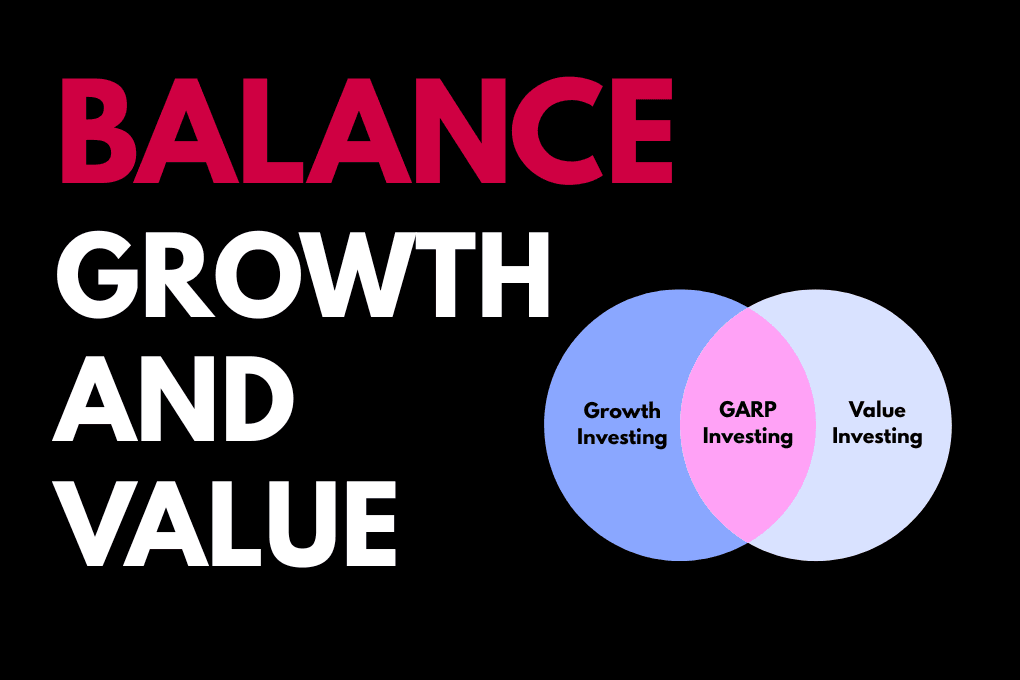
When you first start investing, it’s easy to go overboard. You either hunt for the cheapest stock hoping it’ll explode, or chase the shiniest, most talked-about company without caring about the price. Both usually end in a facepalm moment.
That’s exactly what the GARP strategy is all about: Growth at a Reasonable Price. It’s a middle ground: you pick companies that are actually growing, but make sure you’re not paying a fortune for it. Let’s break it down together.
What Makes GARP Special?
Value investing started with Graham in the 1930s, Buffett refined it by paying fair prices for great businesses, and Lynch popularised GARP by combining growth with sensible valuations.
GARP became an approach that combines the discipline of value investing with the excitement of growth investing.
Instead of chasing only “cheap” penny stocks or blindly buying into hot IPOs, GARP tells us to:
Look for companies that are growing steadily.
Make sure we don’t overpay for that growth.
Think of it as the sweet spot between traditional value investing and pure growth investing. It’s about finding quality businesses with solid growth prospects without getting caught up in the hype or paying an excessive price.
And this is where it gets interesting: retail investors like us are actually better positioned to use GARP than big institutions. Why? Because we have flexibility. We don’t have to buy 50 stocks just to diversify, or stick to regulatory restrictions like mutual funds do. We can use our own experience, industry knowledge, or even everyday observations to pick companies we understand.
And here’s the best part: GARP is perfect for retail investors like us. Why? Because unlike big institutional funds, we:
Have flexibility. We can enter or exit whenever we like.
Face no rigid rules on diversification. We don’t need to hold 50 stocks if we don’t want to.
Can use our personal knowledge to pick sectors and companies we understand.
Big institutional funds often struggle to find and invest in these kinds of small, high-growth companies without moving the stock price, which can limit their returns. This can give individual investors an advantage.
The Four Pillars of GARP
GARP’s strength comes from four guiding principles you can actually follow.
1. Always invest in what we know
We should use our life experience. If we understand a sector deeply, we’re already pretty sorted. Whether it’s our profession, our business, or even the products we use daily, that knowledge helps us spot good companies before the crowd.
2. Balance growth and value
Avoid the two extremes:
Bargain hunting (cheap, low-quality stocks that look tempting but disappoint).
Growth at any cost (trendy, loss-making companies that burn cash).
Instead, look for quality companies at a reasonable price. This strategy helps us see gains when the market is up and also protects our investments when things get rough.
3. Use the PEG ratio
The PEG ratio, or Price/Earnings to Growth ratio, is a valuation metric that helps investors determine if a stock’s price is reasonable when considering its future growth potential. It improves upon the traditional P/E ratio by adding an essential layer of context: a company’s expected earnings growth. A company with a high P/E ratio might seem overvalued on the surface, but if it has a high growth rate, its PEG ratio might reveal that the stock is actually fairly valued or even a good deal. In short, it shows you how much you’re paying for each unit of expected earnings growth.
The P/E ratio is the stock’s current price divided by its earnings per share (EPS). The Earnings Growth Rate is the projected annual growth of the company’s earnings, usually expressed as a whole number (e.g., a 20% growth rate would be represented as 20)

If it’s below 1 (or close to 1) → usually fairly valued or undervalued.
If it’s well above 1 → often overvalued.
This metric is more advanced than just looking at P/E, because it adjusts for growth. A high P/E may still be fine if earnings are growing quickly, but a sluggish company with even a modest P/E can actually be expensive.
4. Favour Consistency
Markets reward companies that consistently compound. Instead of buying flashy stocks that go way up when the market is good and then crash when things turn bad, it’s smarter to focus on companies with more consistent, long-term growth. Instead, give preference to consistent compounders that grow predictably year after year.
How To Apply GARP In Real Life
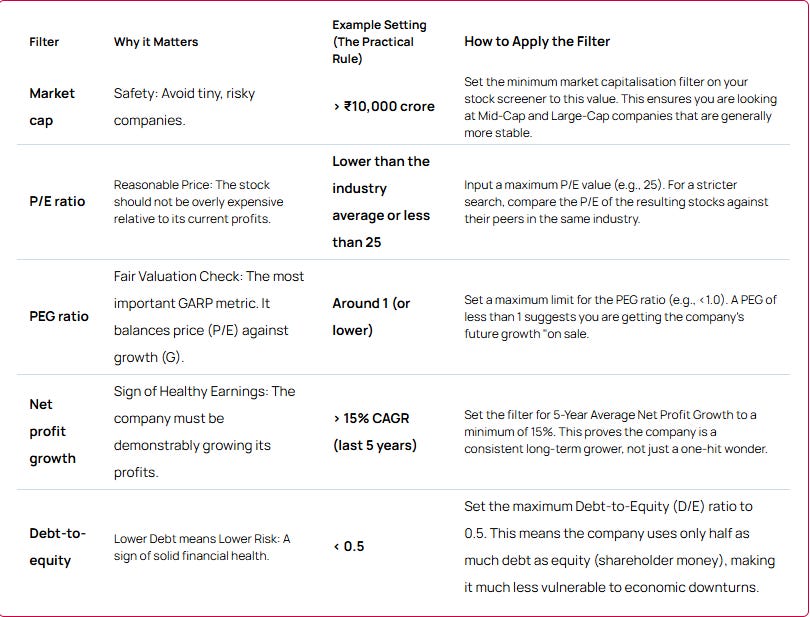
To make things practical, let’s translate these pillars into a checklist. Here’s a simple way to screen for GARP stocks using Finology Ticker.
Companies You Should Prefer vs Avoid
Based on GARP, here are some general patterns to keep in mind:
Preferred Companies
Boring name, boring Industry /sector
Companies in stable or growing industries with consistent demand
Companies with a large market share in a specific niche or unique positioning
Businesses with products or services that are always in demand
Strong insider buying, showing management confidence in the company’s future
Companies to Avoid
Stocks popular in the analyst community
Dependent on a few customers (e.g., 1 customer accounts for 25% -50% of sales)
Companies with big, unproven plans
Companies involved in diversification (diversifying with big acquisition plans)
Businesses with low institutional holding (<25)
Avoid companies with a debt-to-equity ratio of more than 25%
Just using this basic approach can help you avoid a lot of common mistakes.
Why GARP Works
The beauty of GARP is that it’s not about timing the market or chasing fads as much as it’s about buying good businesses at fair prices and letting time do the heavy lifting. This strategy has a “dual objective”:
Protect capital in bad times.
Deliver solid returns in good times.
And that’s exactly what retail investors need. The goal here isn’t overnight wealth, but rather the steady, compounding growth that builds over time.
Final Thoughts...
The market often tempts us with two extremes - dirt-cheap bargains or hyped-up growth stories. Instead of going for the extremes-either super cheap companies or hyped-up growth the most successful long-term investors like Buffett and Lynch have found their best results right in the middle.
That’s the core idea of GARP. It’s a balanced, common-sense strategy that uses tools like the PEG ratio to help you find companies with good growth prospects at a reasonable price. It’s really about consistency.
So next time you’re screening stocks, ask yourself:
👉 Is this a quality company?
👉 Am I paying a fair price for it?
👉 Does it pass the GARP test?
If you can say “yes” to those, you might have found a solid long-term investment.