
The Family That Built Modern India
How Jamsetji, JRD, and Ratan Tata turned ₹21,000 and a garage in Bombay into one of the world's most respected conglomerates across five generations.

There is a saying most Indians have heard at some point: “Chappal Bata ki. Aur naukari Tata ki.” Wear Bata shoes. Work for Tata. It was a generation’s shorthand for a stable, respectable life, delivered in one sentence.
For a long time, most people knew Tata primarily as a salt company. Desh ka namak. That was the visible surface of something far larger. Today, an initial capital of ₹21,000 invested by one man in 1868 has grown into a group generating more than $180 billion in annual revenue and employing over one million people across the world. The group has survived two world wars, independence, nationalisation, a global financial crisis, and more than a century and a half of Indian economic history. Most family businesses do not survive the third generation. The Tatas are on their fifth.
The question worth asking is straightforward: how did a family business not only survive for so long but grow into one of the world’s most respected conglomerates across five generations?
The answer sits in three people. Jamsetji laid the foundation. JRD built the structure. Ratan furnished the house. There were other significant contributors across the decades, but these three defined what Tata is.
Jamsetji Nusserwanji Tata
Born on March 3, 1839, into a priestly family in Navsari, Jamsetji had no interest in following that path. He found his calling in business early and pursued it with a clarity of purpose that tends to produce either great success or great failure. In his case, it produced the former.
At 29, he started a trading company with ₹21,000 in capital. A visit to England introduced him to the textile business. He returned to India, bought a struggling oil mill in Chinchpokli in 1869, converted it into a cotton textile mill, ran it profitably, and sold it for a significant gain two years later.
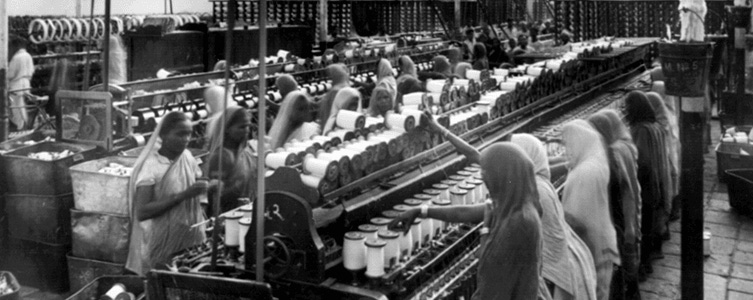
It was the beginning of a pattern: identify an opportunity, execute it better than anyone else, and move forward. From 1880 until his death in 1904, Jamsetji carried four major ambitions: an iron and steel company, a hydroelectric plant, a world-class educational institution, and a grand hotel. He saw only one of them completed in his lifetime.
The Taj Mahal Hotel
Jamsetji visited Watson’s Hotel in Bombay, one of the finest establishments in the city at the time. A sign at the entrance reportedly read: “Dogs and Indians not allowed.” He was turned away.
The Taj Mahal Hotel opened in 1903. It was a ₹4 crore project at a time when that figure was staggering. It was the first building in Bombay to be lit by electricity. It had American fans, German elevators, Turkish baths, and English butlers. India’s first licensed bar opened within its walls. During the First World War, it was converted into a hospital to treat the wounded.
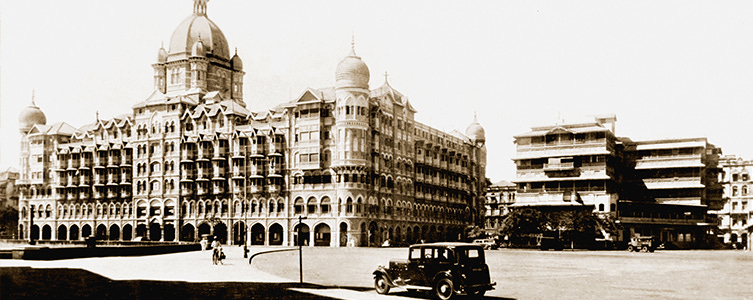
In 2008, during the 26/11 Mumbai terror attacks, Ratan Tata announced that the Tata Group would cover medical expenses for everyone injured in the attacks, extending beyond those wounded inside the Taj itself. That decision said something about the institution that no marketing could replicate.
Jamsetji died in May 1904, before his steel plant, his hydroelectric dam, or his educational institution existed. Each was built after his death, using plans he had left behind. The Indian Institute of Science in Bangalore, the Tata Iron and Steel Company in Jamshedpur, and the Tata Hydroelectric Power Supply Company all trace their origin to his vision.
That is a specific kind of leadership: building things whose completion you will never see.
Jehangir Ratanji Dadabhoy Tata
JRD was the nephew of Jamsetji Tata. He was born in Paris in 1904. He grew up in France, spoke French more fluently than English, and more fluently than any Indian language. He never attended university. He wanted to, but circumstances did not allow it.
He was a passionate aviator. When he became chairman of Tata Sons, starting an airline was his first serious priority. He already held a pilot’s license. An aircraft was all he needed.
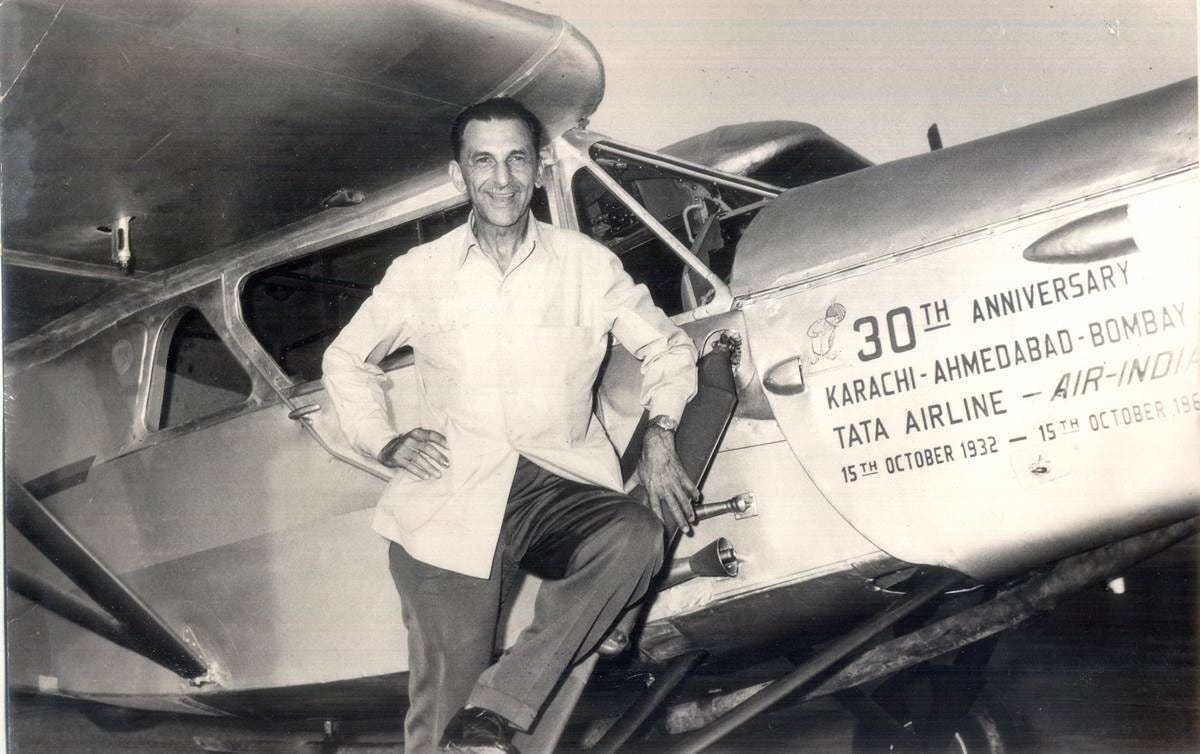
In 1932, Tata Airlines began its first scheduled commercial service, with the inaugural flight operating the Karachi to Bombay route. The airline later became Air India in 1946, giving India its own carrier before independence.
JRD Tata, chairman of Tata Sons, on the 30th anniversary day of the inaugural Karachi-Bombay flight (Source: Indian Express)
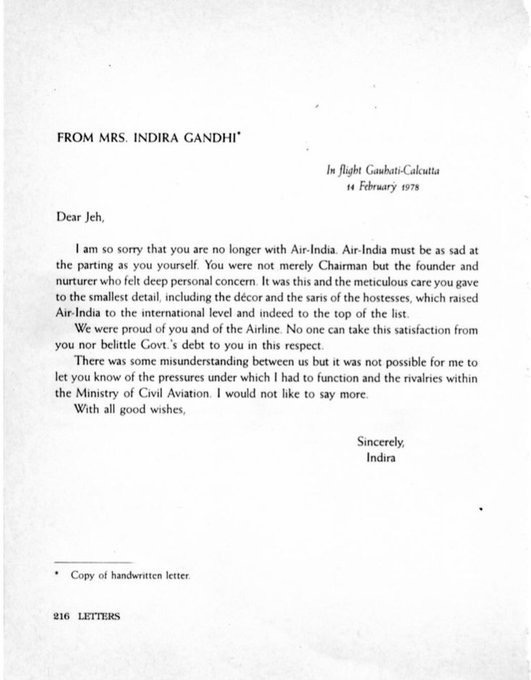
In 1953, Air India was nationalised. JRD opposed it but could not prevent it. In 1978, the Morarji Desai government removed him from the board of Air India. Indira Gandhi wrote him a letter around that time: “We are proud of you and the airline.”
And he kept building. Under his leadership across five decades, the Tata Group expanded from a modest industrial base into one of India’s largest conglomerates.
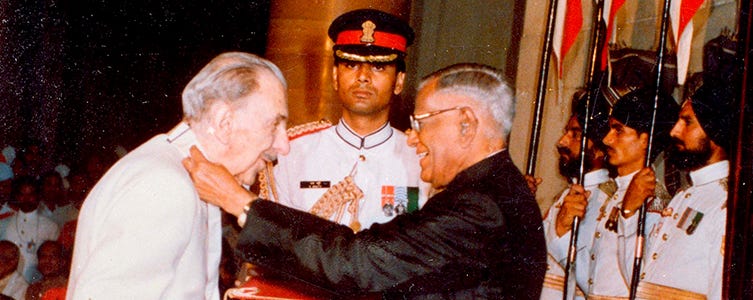
In 1992, he was awarded the Bharat Ratna. His response: “Why me? I don’t deserve it.”
In January 2022, Tata Group completed the acquisition of Air India, taking 100% ownership. It took roughly seven decades for the airline to return to Tata hands. It came back.
Source: Tata
Ratan Naval Tata
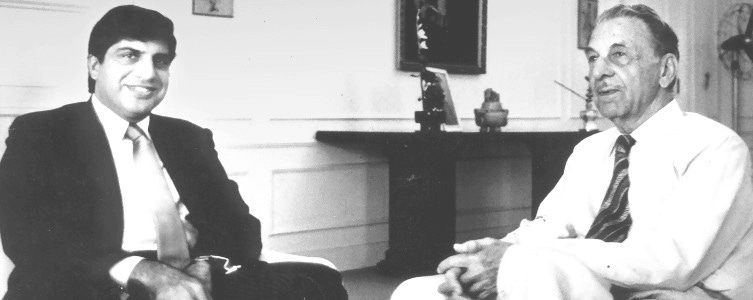
Ratan Tata was born on December 28, 1937. He studied architecture at Cornell and later completed the Advanced Management Program at Harvard Business School. He returned to India and was given NELCO, a loss-making electronics company, as his first assignment. He identified what the previous management had missed and pushed through the changes necessary to turn it around.
In 1991, JRD appointed Ratan as chairman. He was closer to JRD than to his own father, by most accounts. JRD saw in him someone who understood both the Tata ethos and what the future required of it.
The Ford Moment
Tata Motors launched the Indica in 1998, India’s first indigenously designed passenger car. Early sales were disappointing. In 1999, Ratan Tata explored whether Ford might acquire the passenger car business, and the two sides met in Detroit. Accounts of what was said in that meeting have been disputed over the years. What is documented is that Ratan Tata returned without a deal and without any intention of selling.
Nine years later, Ford was in serious financial difficulty. Ratan Tata acquired Jaguar and Land Rover from Ford in 2008 for $2.3 billion.
The Nano
In 2003, Ratan Tata saw a family of four navigating Mumbai’s rain on a single scooter. He decided to build them a car.
The Tata Nano launched at ₹1 lakh, the most affordable car in the world at the time. The engineering behind it was genuinely ambitious. The positioning was the problem. Being marketed as the most affordable car in the world made it a symbol of financial limitation rather than practical aspiration. Sales never matched projections.
It was an excellent idea, executed poorly at the marketing stage. But the intent behind it, spending years of research and development on a product whose primary purpose was people’s comfort rather than profit, was entirely consistent with how the Tata Group has always operated.
The Legacy
Ratan Tata passed away on October 9, 2024, at the age of 86. Prime Minister Modi called him “a visionary business leader, a compassionate soul, and an extraordinary human being.” The Tata Group is now led by Natarajan Chandrasekaran.
Nearly 66% of Tata Sons is owned by philanthropic trusts. Dividends from Tata Sons largely flow to the Tata Trusts, which fund education, healthcare, and community development. JRD once said he simply wanted India to be a happy country. That was his measure of success.
Well over a century in, the institution three men built across three generations is still standing, still growing, and still giving most of what it earns away.
That combination, sustained across so much history, is rarer than any financial metric can capture.
The Tata Group has outlasted empires, governments, and entire industries. But the question worth sitting with is this: in a country building its next generation of great companies, what does it take to build something that lasts not years, but centuries?
Tell us in the comments. Which part of the Tata story surprised you the most?
Integrity